


RFID UHF vs BLE
Differences, Advantages and Applications in Industrial and Logistics Environments
RFID UHF and Bluetooth Low Energy (BLE) are two key technologies for asset identification, traceability and real-time location. Discover how they work, what sets them apart, and when to use one, the other, or both in industrial and logistics environments.
When it comes to asset traceability, automatic identification and real-time tracking, RFID UHF and Bluetooth Low Energy (BLE) are among the most widely used wireless technologies in industrial and logistics environments. Although both rely on radio waves to exchange information, they were designed to address different operational needs and are best suited for different types of applications.
What is RFID UHF technology?
RFID stands for Radio Frequency Identification, a technology that automatically identifies an object using an RFID tag and an RFID reader. UHF (Ultra High Frequency), operating between 860 and 960 MHz depending on regional regulations, is the most widely adopted RFID technology for industrial and logistics applications thanks to its long reading range and its ability to identify multiple tags simultaneously.
Compared to Low Frequency (LF) and High Frequency (HF) RFID systems, UHF technology is the preferred solution whenever large volumes of items need to be identified quickly and efficiently.
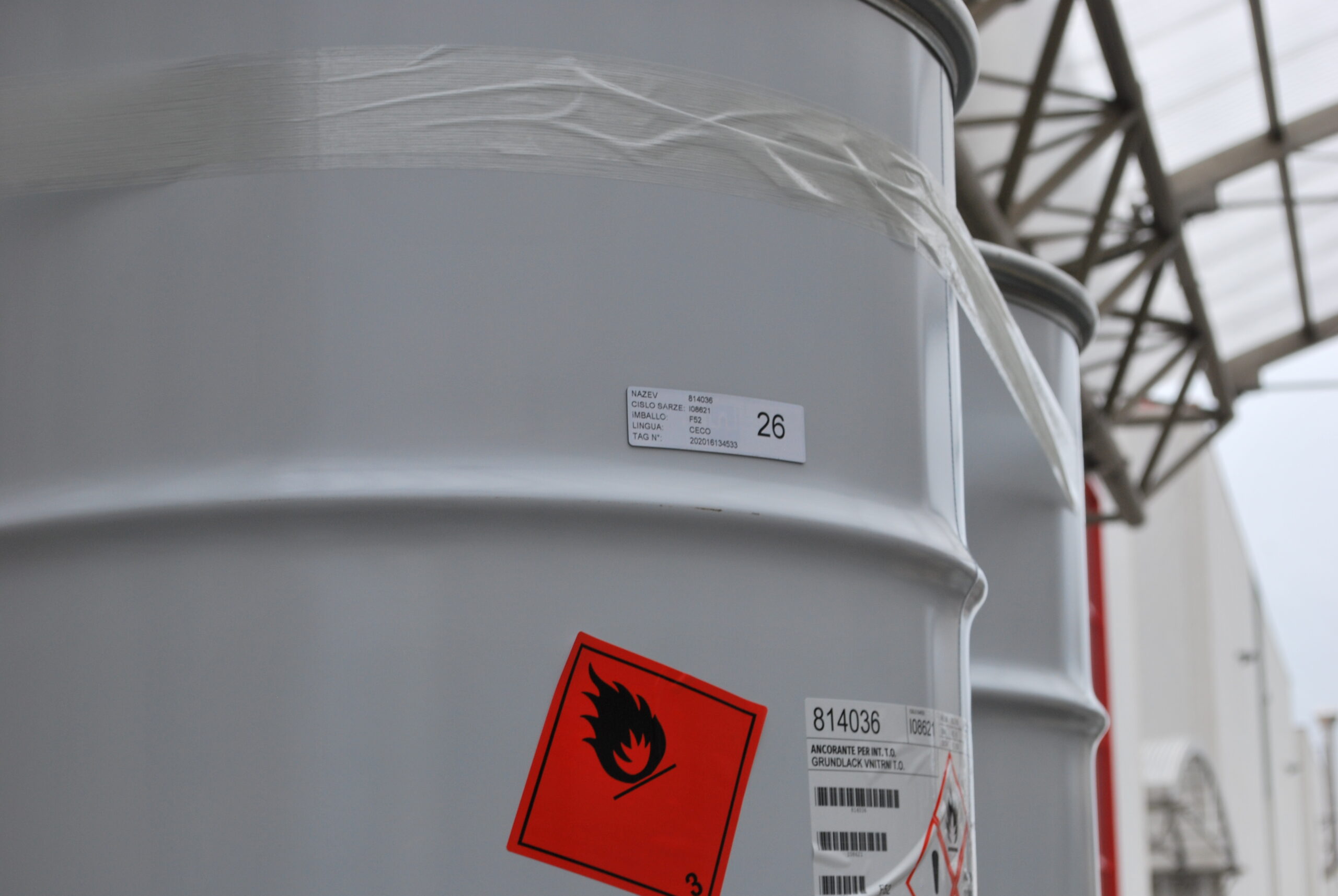
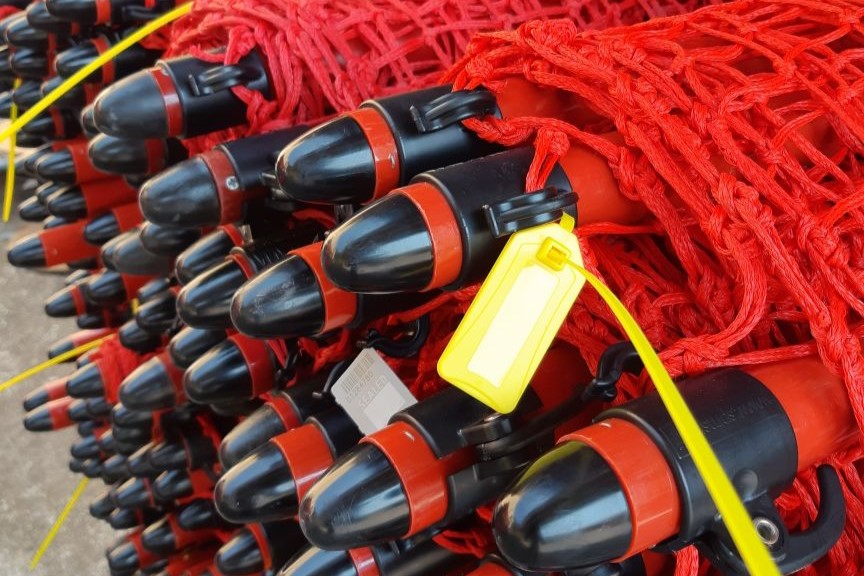
Depending on the application and operating environment, RFID tags are available in a wide variety of formats and materials, ranging from textile tags used in industrial laundries to rugged on-metal tags for containers and metallic assets, as well as adhesive RFID labels designed for warehouse management and logistics operations.
The operating principle is straightforward: the RFID reader emits a radio signal, the passive RFID tag harvests the energy required to power itself and immediately transmits its unique identifier. This entire process takes place within milliseconds and without any physical contact.
One of RFID’s greatest strengths is its ability to read hundreds of tags simultaneously, making it the standard technology for many industrial automation processes.
Typical RFID applications include:
- Automated warehouse management
- Fast and accurate inventory counting
- Access control
- Pallet, container and product traceability
- Tool and equipment management
- Industrial laundry and textile tracking
- Logistics and supply chain monitoring
The main advantages of RFID include:
- Low tag cost
- Long operational lifetime
- Simultaneous reading of hundreds of tags
- Excellent scalability for high-volume applications

What is Bluetooth Low Energy (BLE)?
Bluetooth Low Energy (BLE) is a wireless communication technology specifically designed to provide low-power data transmission while maintaining reliable wireless connectivity.
BLE devices are powered by an internal battery and periodically broadcast radio signals that can be received by smartphones, gateways, BLE repeaters and dedicated infrastructure. This operating principle allows BLE beacons to continuously communicate their presence and, in many cases, additional information that can be used for asset monitoring and IoT applications.
One of BLE’s most distinctive features is the flexibility of its data transmission. Besides broadcasting their presence, BLE beacons can transmit different types of information through several advertising formats, including:
- iBeacon, Apple’s protocol widely used for proximity services, indoor positioning and mobile interactions.
- Eddystone UID, developed by Google to broadcast a unique device identifier.
- Eddystone URL, which allows a beacon to broadcast a web address directly without requiring a dedicated mobile application.
- Eddystone TLM (Telemetry), used to transmit diagnostic information such as battery level, device temperature, uptime and other operating parameters.
This flexibility makes BLE suitable not only for asset location but also for advanced IoT applications where monitoring device status or environmental conditions is equally important.
Industrial BLE beacons can also integrate optional sensors such as accelerometers, temperature sensors, humidity sensors and motion detection, allowing companies to monitor not only the position of an asset but also its operating conditions.
Another key feature of BLE is the Advertising Interval, which defines how frequently a beacon transmits its signal. Shorter intervals provide more frequent position updates but increase battery consumption, while longer intervals significantly extend battery life.
These characteristics make Bluetooth Low Energy particularly well suited for indoor positioning, real-time asset tracking and Industrial IoT applications.
Typical BLE applications include:
- Indoor positioning
- Real-time asset tracking
- Vehicle and equipment monitoring
- IoT applications
- Personnel safety
- Smartphone and tablet integration
Explore our range of Beacon BLE
Key Differences Between RFID UHF and BLE
Although both technologies rely on radio frequency communication, RFID UHF and BLE are based on different operating principles and have been developed to address different requirements.
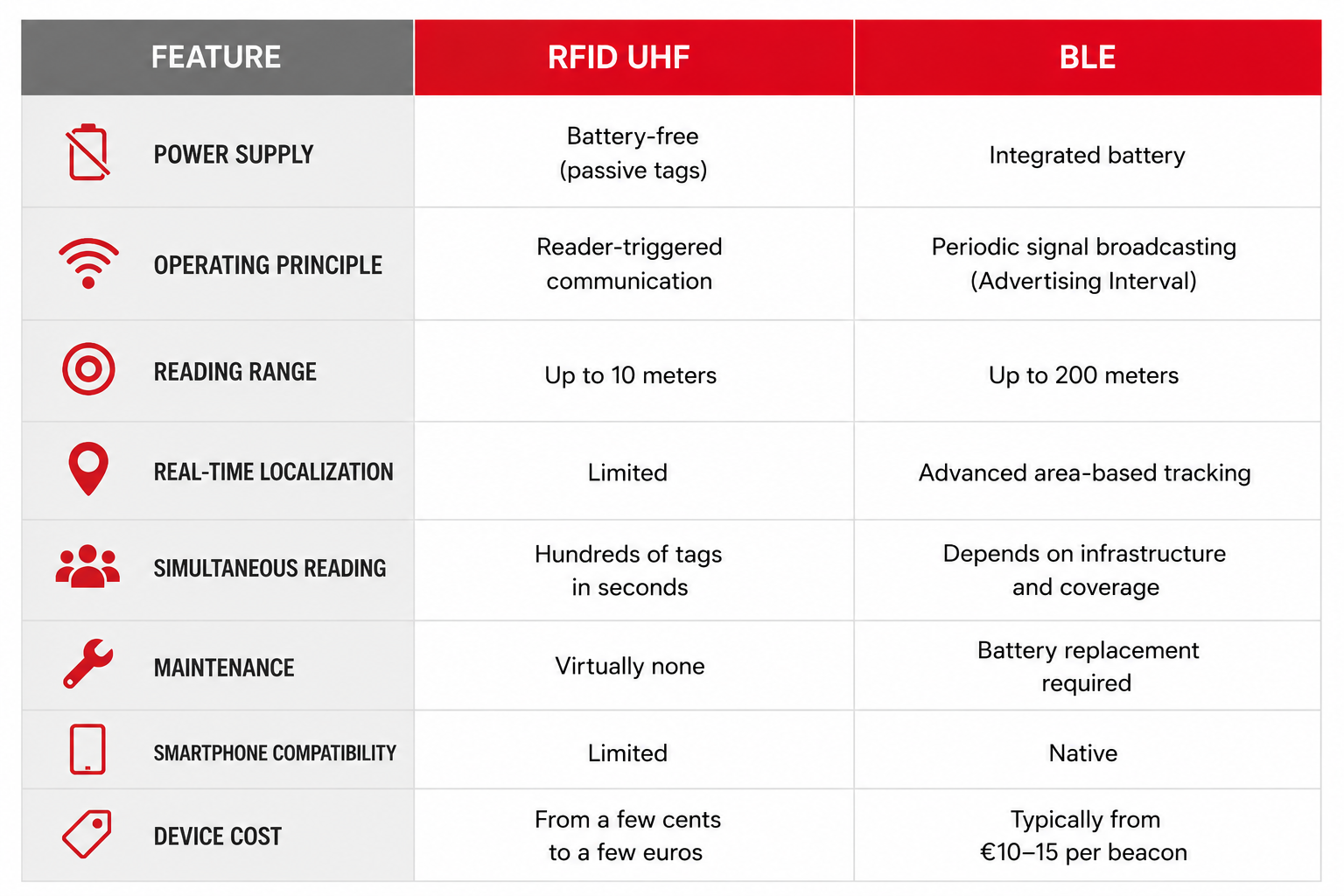
One of the most significant differences is how the devices are powered. Passive RFID tags do not contain a battery and are activated only when they enter the electromagnetic field generated by an RFID reader. This eliminates battery maintenance and helps reduce the overall cost of ownership.
BLE devices, on the other hand, are battery-powered and periodically broadcast radio signals. This enables continuous monitoring but also requires battery management. Battery life depends on several factors, including battery capacity, transmission power and, above all, the configured Advertising Interval. Industrial BLE beacons commonly use high-capacity lithium batteries such as CR2477 cells, providing an operational lifetime ranging from several months to several years. Under optimized configurations, battery life can typically reach 4 to 5 years.
Communication methods also differ considerably. RFID operates on a “reader-to-tag” principle, meaning that a tag only responds when interrogated by an RFID reader. BLE follows a continuous broadcasting model, where beacons periodically transmit signals that can be received by gateways, smartphones or other compatible infrastructure. In practice, RFID records the passage of an item through a defined reading point, while BLE continuously reports the presence of an asset within a monitored area.
Reading range is another key differentiator. Depending on the application and antenna configuration, UHF RFID systems typically achieve read distances of up to 10 meters or more. BLE devices can cover significantly greater distances, reaching over 100 meters—and in some cases up to 200 meters—under favorable conditions. As a result, RFID is commonly used to create precise control points, whereas BLE is better suited for monitoring larger areas.
Cost is another important factor when selecting the appropriate technology. Passive RFID tags are available at very low cost, ranging from a few cents to a few euros depending on their design and application. BLE beacons, being active electronic devices with integrated batteries, typically start at around €10–15 per unit, with pricing varying according to features, sensors and production volumes.
Perhaps the most important distinction lies in the purpose of each technology. RFID was developed primarily for the automatic identification of products, assets and materials as they pass through a reading point. BLE, by contrast, excels at determining the location of an asset and monitoring its movements over time. In short, RFID is optimized for identification, while BLE is designed for localization and continuous tracking.
The infrastructure required is also different. RFID systems rely on dedicated readers and antennas installed at specific control points. BLE solutions can leverage gateways, access points, repeaters and even smartphones equipped with Bluetooth connectivity. The complexity of the infrastructure ultimately depends on the objectives of the project and should always be evaluated during the system design phase.
RFID UHF vs BLE Comparison
Which Technology Should You Choose?
There is no universally “better” technology. RFID UHF and BLE were developed to solve different challenges, and the best choice depends entirely on the application’s requirements.
If the objective is to identify large numbers of products, containers or assets quickly and efficiently, RFID UHF offers outstanding performance thanks to its high reading speed, scalability and low-cost passive tags.
If, however, the goal is to know where equipment, vehicles or personnel are located at any given time and monitor their movements continuously, BLE provides capabilities that RFID alone cannot offer.
In many real-world industrial environments, the best solution is not choosing one technology over the other but combining both. RFID can automate the identification of products and materials at key process points, while BLE provides continuous visibility of mobile assets throughout the facility.
Ultimately, the right technology is not determined by which one is more advanced, but by which one best meets the operational requirements of the project.
do you want to know more?