


Packaging for UHF RFID fanfold labels
from printing issues to a smooth workflow
Dedicated packaging for UHF RFID fanfold labels is not just about protecting the tag: it keeps the stack compact, makes printer loading easier and helps reduce jams, waste and manual adjustments. Redesigning the packaging around the printing process turns a potentially critical media format into a reliable, tidy and easy-to-handle tool for operators.
In the world of automatic identification, a UHF RFID label is a technological component that enables traceability, inventory control, process automation and also security and anti-counterfeiting functions. For this reason, it is not enough to design the tag properly: the format and the packaging of the labels also need to be consistent with the way the customer uses them.
In the specific case we are analysing, we are dealing with UHF RFID labels intended for printing, supplied in fanfold format, that is, stacked in a “zig-zag”. In theory, the roll format would be the ideal solution for printing, because it ensures continuous media feed and very intuitive loading into the printer. In this project, however, the labels are quite large: converting them into rolls would result in excessively bulky reels that are difficult to handle, store and ship. Fanfold therefore becomes the most sensible choice, provided it is combined with packaging specifically designed to keep it neat and easy to handle during printing.
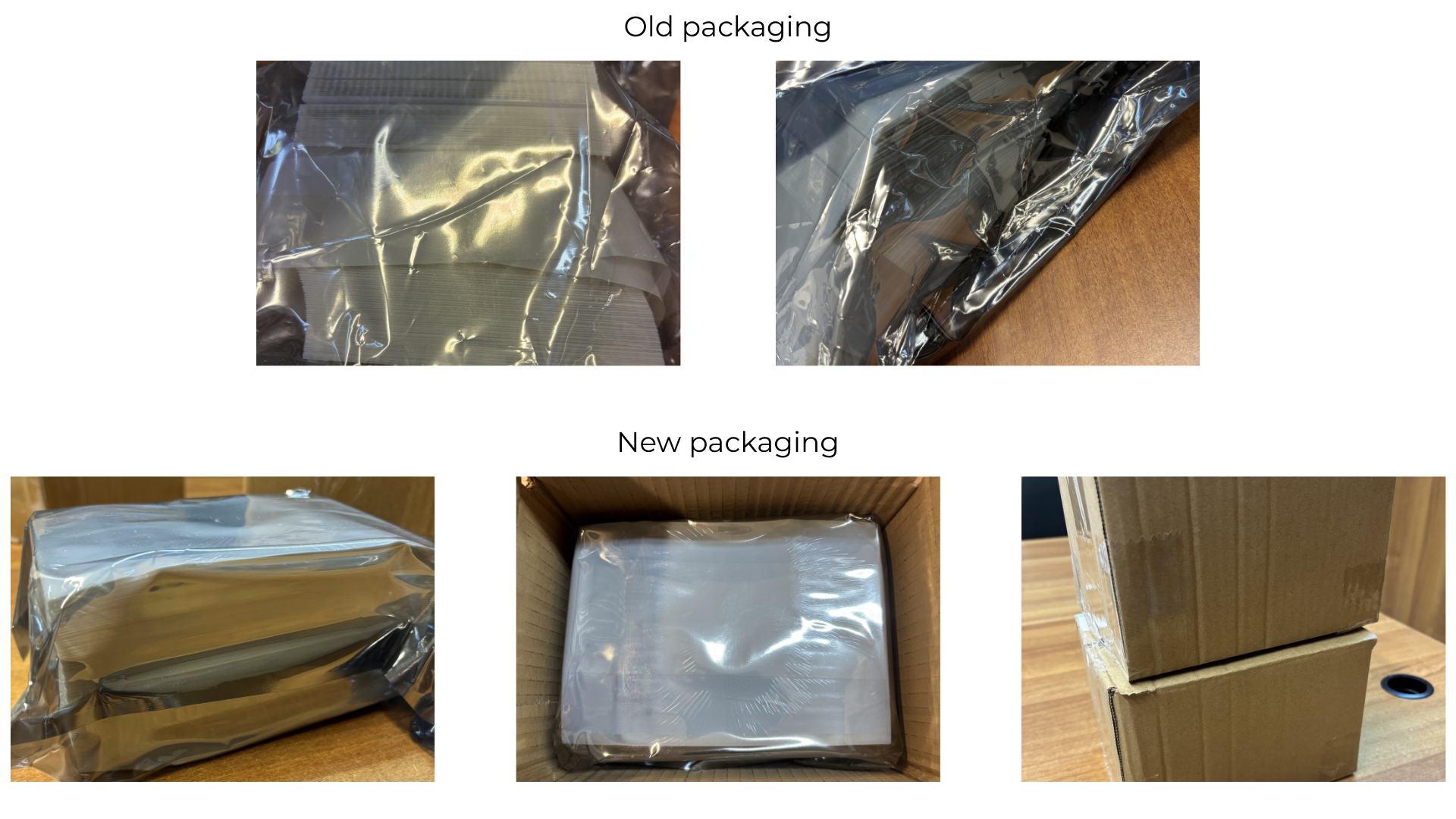
With the first packaging system adopted, significant critical issues emerged. The labels tended to move inside the box, the stack did not remain compact and aligned and, once the packaging was opened, the customer often found a “disassembled” block that had to be manually realigned before it could be used. This misalignment also translated into greater difficulties during printing: it was enough for the fanfold to be slightly skewed for it to enter the paper path at an angle, increasing the risk of jams, printing errors and, in the most extreme cases, even mechanical damage to the printer. All this resulted in a clear waste of time for the operator, more scrap and the perception of a medium that was not very practical and difficult to manage.
Starting from these observations, the packaging was redesigned with the goal of keeping the fanfold labels perfectly in order and making them easier to load into the printer. The new packaging format has been designed to block movement of the stack and keep it compact and aligned. In this way, the labels remain in order and the entire block can be taken and loaded into the printer in a much more intuitive way.
From the end customer’s point of view, the change is immediately noticeable: the labels reach the printing phase in better condition, both aesthetically and functionally.
discover our UHF RFID labels
The images of the two packaging solutions visually show this improvement. In the initial situation, the fanfold tends to come apart and the labels may appear bent or damaged, with a negative effect both on the perception of the product and on the reliability of the printing process. In the new scenario, by contrast, the stack appears compact, neat and protected: the labels are easy to handle and simple to position in the printer.
Ultimately, this project shows how a targeted intervention on packaging can make a real difference. The tag itself does not change; what changes is the way it is presented and handled. This results in smoother processes, fewer unexpected issues and a technology that fully meets the customer’s needs.
do you want to know more?